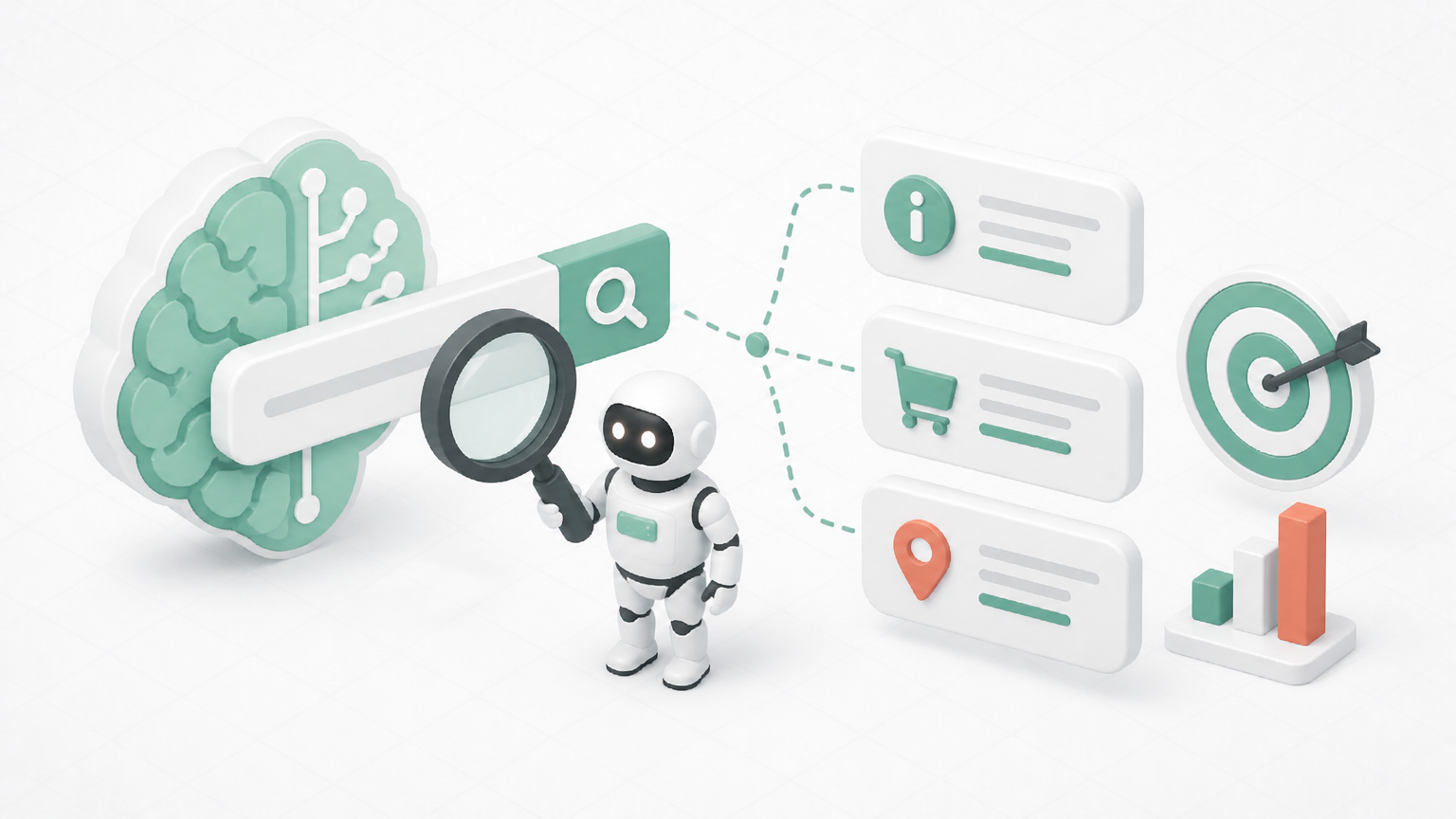
How AI Interprets Search Intent
Bastian W.
Co-Founder of Keupera
Search visibility is no longer just about matching keywords. It is about matching meaning. If your content ranks poorly despite solid on-page SEO, the problem is often not authority or links, it is intent mismatch.
That is where AI changes the game. Modern search engines do not simply scan for exact phrases, they interpret context, infer goals, and predict what a user actually wants from a query. For startups and SEO agencies, that shift matters. It affects how you structure pages, map keywords, and prioritize content across the funnel.
If you want better rankings, stronger engagement, and fewer wasted content briefs, you need to understand how machines interpret queries. Once you see how machines interpret queries, you can build pages that align with what search engines are trying to deliver, not just what users type.
What AI and Search Intent Really Mean
At a basic level, search intent is the purpose behind a query. A user may want to learn something, compare options, reach a specific website, or make a purchase. The words in the query matter, but the goal behind those words matters more.
AI helps search engines bridge that gap. Instead of treating a query like a static string of text, machine learning models evaluate language patterns, relationships between terms, historical behavior, device context, and likely outcomes. In plain terms, the search engine asks, What is this person trying to do right now?
This is why two similar keywords can produce very different SERPs. A query like “best CRM for startups” usually signals comparison and evaluation. A query like “HubSpot login” is navigational. A query like “buy CRM software” shows strong transactional intent. AI recognizes those differences even when the wording is messy, incomplete, or conversational.
This is also why exact-match optimization has lost ground. Search engines have become better at understanding synonyms, topic depth, and semantic relevance. You do not need to repeat the same phrase awkwardly across a page, you need to satisfy the intent with clarity, structure, and useful information.
Why This Matters More Now
Search behavior has changed. Users speak to devices, type fragmented questions, and expect immediate relevance. They might search “how to reduce churn saas,” “best churn tools,” and “customer retention benchmarks” within the same session. Those look like separate queries, but AI can connect them as part of a broader problem-solving journey.
For marketers, that creates both a challenge and an opportunity. The challenge is that surface-level content is easier for search engines to dismiss. The opportunity is that strong intent alignment can help smaller brands compete, even against larger domains, when they create pages that genuinely solve the user’s next question.
Key Aspects of How Machines Interpret Queries
Understanding AI and query interpretation starts with how search engines process language. The mechanics are complex, but the strategic takeaway is straightforward. Machines are trying to identify meaning, context, and likely satisfaction.
Query Understanding Goes Beyond Keywords
Older search systems leaned heavily on lexical matching. If a page contained the same words as the search query, it had a better chance to rank. That still matters to a degree, but modern AI systems also evaluate semantic similarity.
This means a page can rank for a query even if it does not use that exact wording. If your article covers customer acquisition cost in depth, search engines may understand that it is relevant to users searching for CAC benchmarks, cost to acquire SaaS users, or reducing acquisition spend. The model recognizes related concepts, not just repeated terms.
For agencies, this changes keyword strategy. Instead of assigning one page to one exact phrase, you should build pages around intent clusters. A strong page often serves a family of related searches because it addresses the broader need behind them.
Intent Classification Shapes the SERP
Search engines commonly map queries to broad intent categories such as informational, navigational, commercial, and transactional. AI helps assign those categories at scale, often with more nuance than traditional SEO frameworks suggest.
Here is a simple way to think about it:
Intent Type | What the User Wants | Typical SERP Features | Best Content Format |
|---|---|---|---|
Informational | To learn or understand | Featured snippets, People Also Ask, guides | Educational articles, explainers |
Navigational | To reach a specific brand or page | Homepage links, sitelinks | Brand pages, login pages, location pages |
Commercial | To compare or evaluate | Review pages, comparison pages, list posts | Comparison content, category pages |
Transactional | To act or buy | Product pages, ads, shopping features | Product pages, landing pages, sign-up pages |
This classification affects everything from title tags to content depth. If the SERP is dominated by product pages and you publish a blog post, you are likely fighting the wrong battle. If the results are educational and you push a hard-sell landing page, the mismatch is just as costly.
Context Helps Machines Resolve Ambiguity
Many queries are ambiguous. “Apple” could mean the company or the fruit. “Migration tools” could refer to data migration, cloud migration, or website migration. AI resolves that ambiguity by looking at surrounding signals.
Those signals can include prior searches, location, device type, trending topics, and aggregate click behavior. If a user searches “apple stock price,” the engine has a clear financial context. If they search “apple calories,” the food context becomes obvious. The words themselves are only part of the story.
This is especially important for B2B and SaaS brands. Industry terms often overlap across markets. A page optimized for “onboarding platform” may compete in HR, product adoption, and customer success spaces at once. Without context-rich copy, search engines may struggle to place it correctly.
Entities and Relationships Matter
AI-powered search increasingly relies on entities, people, brands, products, places, concepts, and the relationships between them. This helps machines move from matching strings to understanding real-world meaning.
If your content consistently connects your brand to a topic, use case, and category, search engines gain confidence in what your site represents. For example, if your startup publishes coherent content around technical SEO audits, crawling, indexation, and Core Web Vitals, AI can more easily classify your site as relevant to that topical space.
This is why topical authority is not just a publishing volume game. It is a clarity game. Machines interpret patterns. The clearer the topical relationships across your site, the easier it is for search systems to understand when your pages deserve visibility.
User Behavior Feeds the Feedback Loop
Search engines do not rely only on language models. They also learn from behavior at scale. If users consistently click a result, stay engaged, and avoid returning to the SERP immediately, that can reinforce the page’s usefulness for that intent.
This does not mean every engagement metric is a ranking factor in a simplistic sense. It means AI systems can observe satisfaction patterns across millions of interactions. If a page repeatedly disappoints users for a query, the search engine has signals that the match may be poor.
For agencies, this is where SEO and UX intersect. Intent alignment does not stop at ranking. The page has to deliver on the promise of the query quickly. Clear intros, strong information scent, and easy navigation all help users confirm they landed in the right place.
SERP Features Reveal Intent in Real Time
One of the fastest ways to understand how machines interpret a query is to study the SERP itself. Search engines are showing you their current best guess about intent.
If you see videos, the engine may believe visual explanation is useful. If you see calculators, templates, or product comparison widgets, the engine may infer that users want practical evaluation tools. If People Also Ask dominates, the query likely opens a broader informational journey rather than a single-answer destination.
That makes SERP analysis a strategic habit, not just a keyword research step. Before creating content, check what search engines are already rewarding. They are effectively exposing how their AI systems classify that query.
How AI Changes Content Strategy for Startups and Agencies
The practical impact of AI and search intent is not theoretical. It reshapes how you plan, write, and optimize content.
Keywords Become Topics With Jobs To Do
A useful keyword is no longer just a traffic opportunity, it is a signal of a specific task the user wants completed. Your job is to identify that task and build the best page for it.
Take the query “SEO audit tool.” Some users want to compare software. Others want to understand what an audit includes. Others are ready to start a trial. A single page can sometimes address adjacent needs, but often the better strategy is to create separate pages for separate moments in the journey.
This is where many content programs stall. Teams chase volume but ignore task alignment. The result is content that ranks inconsistently, converts poorly, and cannibalizes itself.
Content Depth Must Match Intent Depth
Not every query deserves a 3,000-word guide. Not every high-value term can be satisfied with a thin landing page. AI helps search engines evaluate whether the depth and format of your content match the user’s likely expectations.
If the query implies early-stage education, detailed explanation helps. If the query implies immediate action, clarity and conversion elements matter more than long-form exposition. Matching depth to intent is often more important than simply adding more words.
This is good news for lean teams. You do not need to overproduce. You need to publish the right asset for the right query. Precision beats volume when resources are limited.
Internal Linking Supports Intent Pathways
Search intent rarely exists in isolation. A user searching for a definition today may be comparing vendors tomorrow. AI models understand these relationships, and your site should too.
Internal linking helps create a logical journey between informational, commercial, and transactional pages. A guide on technical SEO can link naturally to an audit checklist, a service page, and a platform demo. That structure helps users progress, and it helps search engines understand the hierarchy and purpose of your content ecosystem.
For SaaS companies and agencies, this is one of the easiest wins. Do not treat blog content and money pages as separate silos. Connect them around intent.
How to Get Started With AI-Driven Search Intent Optimization
You do not need to build your own language model to benefit from this shift. You need a disciplined way to read queries the way search engines do.
Start With the SERP, Not the Spreadsheet
Keyword tools are useful, but they can flatten nuance. A term may look attractive based on volume and difficulty, yet the live SERP may reveal an intent you are not equipped to serve.
Search the term manually. Review the top-ranking pages. Check whether the results are educational, commercial, local, branded, or transactional. Look for featured snippets, videos, comparison pages, and product-led results. That tells you how AI currently interprets the query.
If your planned content format does not match what appears on page one, revise before you publish. That step alone can save weeks of wasted production.
Group Keywords by Intent, Not Just Similarity
Many teams cluster keywords by lexical overlap. A stronger method is to cluster by the problem the user is trying to solve.
For example, “what is domain authority,” “how domain authority works,” and “domain authority meaning” belong together because they serve the same learning intent. “Increase domain authority” points to a more action-oriented need. “Best domain authority checker” shifts into tool evaluation. Similar topic, different jobs.
This distinction improves page mapping and reduces cannibalization. It also makes briefs better. Writers can focus on user outcomes instead of mechanically inserting related phrases.
Build Pages Around Query Satisfaction
Once you identify intent, design the page to satisfy it quickly. That begins with the headline and intro. Users and search engines both need immediate confirmation that the page fits the query.
Then structure the page around the natural next questions. If someone wants to understand backlinks, they usually also want to know why backlinks matter, how quality is measured, and how to earn them safely. Anticipating those adjacent needs increases relevance and keeps the page aligned with how AI evaluates completeness.
A useful editorial check is simple: if someone landed here from search, would they need to go back to Google for the basics? If yes, the page likely needs stronger intent coverage.
Use Structured Signals Carefully
Metadata, schema, headings, and anchor text still matter because they help clarify what a page is about. They are not shortcuts, but they do reduce ambiguity.
For example, a comparison page should look and read like a comparison page. A product page should clearly communicate features, use cases, and conversion paths. Strong structure helps both crawlers and users understand the page’s purpose.
This is where consistent SEO operations pay off. Clean information architecture, descriptive internal links, and accurate schema create a stronger interpretive environment for search engines.
Measure Intent Fit With Performance Signals
Once content is live, monitor how well it aligns with intent. Rankings alone are not enough. A page can rank and still fail if users bounce, do not convert, or trigger the wrong journey.
Watch for these practical signals:
CTR trend: Low click-through rates may suggest your title and description do not match perceived intent.
Engagement quality: Weak time-on-page or shallow interaction can indicate users expected something else.
Conversion alignment: Strong traffic with poor downstream action often points to the wrong page type for the query.
Query drift: Search Console can reveal whether Google is associating your page with the searches you intended.
These signals help you refine content after launch. Intent optimization is not a one-time task, it is an ongoing calibration process.
Common Mistakes When Optimizing for Search Intent
A frequent mistake is assuming every keyword with traffic deserves a blog post. It does not. Some queries require a feature page, pricing page, category page, or comparison page. Choosing the wrong format creates friction before the user even starts reading.
Another issue is overgeneralization. Teams sometimes create one broad page and try to rank it for everything in a topic area. That usually weakens intent specificity. A page that tries to teach, compare, and convert all at once often satisfies none of those goals well.
There is also a tendency to equate AI optimization with writing for machines. That is backward. Search engines are using AI to model human needs more effectively. The best response is still to create clearer, more useful content for people. Good SEO now looks more like sharp product marketing and less like keyword stuffing.
A Simple Framework You Can Apply Now
If you want a practical operating model, use a four-part filter before creating or updating any page.
Question | What to Ask | Why It Matters |
|---|---|---|
Intent | What is the user trying to accomplish? | Aligns the page with the actual search goal |
Format | What page type is winning in the SERP? | Prevents mismatch between content and results |
Depth | How much explanation or proof is expected? | Helps match the level of detail to the query |
Next Step | What should the user do after this page? | Connects SEO traffic to business outcomes |
This framework is simple, but it forces discipline. It also creates consistency across agency teams, writers, strategists, and founders reviewing content investment.
Conclusion
AI has made search intent more central, not less. Search engines now interpret queries through meaning, context, entities, and likely user satisfaction. That changes how you should approach keyword research, content planning, and on-page optimization.
For startups and SEO agencies, the advantage is clear. When you understand how machines interpret queries, you stop publishing pages that merely mention a term and start building assets that solve the right problem. That is what drives durable rankings.
Your next step is practical. Pick five high-value keywords. Review the live SERPs. Identify the dominant intent behind each one. Then check whether your current pages truly match that intent in format, depth, and outcome. That process will reveal more SEO opportunity than another generic content calendar ever will. Learn more about AI SEO and how it differs from GEO and SEO.
More in AI & GEO
Keep reading

How AI and Google's Ranking Algorithm Work Together
AI-driven systems are changing how search engines interpret queries and content. This guide explains what that means for your SEO strategy, how to use AI responsibly, and where to focus effort to win …

How to Use AI to Write SEO Content: Best Practices and Risks
AI can help you publish faster, cover more keywords, and reduce content production costs. It can also flood your site with thin pages, factual errors, and generic copy that never ranks. That tension i…

Semantic SEO: Optimize for Meaning, Not Just Keywords
Most SEO content fails for a simple reason. It targets phrases, but misses intent. That gap matters more than ever. Search engines no longer rank pages only because they repeat a keyword in the title,…