
How AI and Google's Ranking Algorithm Work Together
Bastian W.
Co-Founder of Keupera
AI-driven systems are changing how search engines interpret queries and content. This guide explains what that means for your SEO strategy, how to use AI responsibly, and where to focus effort to win sustainable rankings.

How AI and Google's ranking algorithm work together
Search visibility is harder to win than ever. You are not just competing on keywords anymore. You are competing on usefulness, clarity, trust, and the ability to meet search intent better than every other result on the page.
That is where the relationship between AI and Google's ranking algorithm matters. If you run a startup or manage SEO for clients, you need to understand two things at once, how Google uses machine learning to interpret content and queries, and how you can use AI responsibly to build stronger pages, better workflows, and more defensible organic growth.
The good news is that Google is not ranking content because a human or a machine wrote it. Google is trying to rank content that helps people. Once you understand that principle, the role of AI becomes clearer. It is not a shortcut to rankings, it is a force multiplier for research, optimization, and content quality when used with strategy and oversight.
What it really means when AI and Google's ranking systems interact
When people talk about Google’s ranking algorithm, they often imagine a single formula. In reality, Google uses a large set of systems and signals to evaluate pages, interpret queries, understand meaning, and determine which results deserve visibility.
AI plays a major role in this process. Google uses machine learning and language models to better understand search intent, relationships between words, content quality patterns, and user satisfaction signals. That means ranking is no longer a simple match between a keyword and a page. It is an interpretation problem, and AI helps Google solve it at scale.
For marketers, this changes the game. Old SEO tactics built around rigid keyword repetition or thin landing pages are less effective because Google has become better at understanding context. A page does not win just because it includes a phrase several times. It wins because it answers the query well, demonstrates credibility, and provides a better experience than alternatives.
Google is looking for helpful, people-first content
This distinction matters most. Google’s systems are designed to reward people-first content. That means content created to satisfy a real need, not content generated primarily to manipulate rankings.
If you use AI to draft ideas, cluster topics, improve structure, or speed up production, that alone is not a problem. The issue starts when AI is used to mass-produce low-value pages with no original insight, no expertise, and no editorial review. In that case, the content may be easy to publish, but it is unlikely to perform well for long.
A useful way to think about it is this, AI can help you create content faster, but it cannot automatically create authority. Authority still comes from experience, evidence, clarity, and trust.

Why this matters for startups and agencies
Startups need leverage. Agencies need repeatable results. AI offers both, but only if it fits into a sound SEO strategy.
For startups, AI can reduce the cost of content ideation, SERP analysis, on-page optimization, and content refreshes. Link: content ideation, SERP analysis, on-page optimization. That makes it easier to compete in crowded markets without building a huge editorial team on day one.
For agencies, AI can improve delivery speed, standardize workflows, and uncover opportunities across multiple client accounts. You can scan large content inventories, identify ranking gaps, detect cannibalization, and prioritize pages with the highest upside. Link: scan large content inventories and identify ranking gaps. But the strategic layer still matters. Clients do not pay for raw output. They pay for outcomes.
Key aspects of how AI and Google's ranking algorithm work together
To understand the connection, you need to look at where AI influences search and where it influences your SEO process. The interaction happens on both sides.
AI helps Google understand search intent
A keyword is rarely as simple as it looks. When someone searches for "best CRM for startups," Google has to interpret whether the user wants product comparisons, pricing guidance, setup advice, or category education.
AI helps Google infer this intent by analyzing language patterns, user behavior at scale, and the relationships between entities and concepts. That is why pages that align tightly with the real purpose of a query usually outperform pages that only target the literal phrase.
This has direct implications for your content strategy. You should build around topics and intent, not just isolated keywords. Link: topics and intent. A strong page anticipates follow-up questions, addresses comparison points, and resolves friction before the visitor has to return to the SERP.
AI helps Google evaluate relevance beyond exact-match keywords
Modern search is semantic. Google can understand that related terms, synonyms, and conceptually connected phrases often point to the same need.
That means a page can rank without using a keyword in its exact raw form, as long as the page covers the topic comprehensively and naturally. This is one reason over-optimized copy often underperforms. It may repeat the target phrase, but still fail to demonstrate depth.
For SEO teams, this is an opportunity. Instead of forcing awkward phrasing, you can write naturally, cover the topic with precision, and use supporting language that signals true topical relevance. This usually produces better readability and stronger engagement, which supports performance over time.
AI supports Google's quality systems
Google uses multiple systems to assess quality, trust, and usefulness. While the exact weighting is not public, the direction is clear. Pages that look thin, generic, duplicated, or untrustworthy are less likely to sustain rankings.
AI helps Google identify patterns associated with low-value content. That includes pages written for search engines first, content farms, scaled duplication, and pages that add little beyond what is already available. This is why publishing at volume without differentiation is increasingly risky.
At the same time, AI can help you improve quality on your side. You can use it to identify missing subtopics, simplify confusing language, compare your page against top-ranking competitors, and surface content decay. Used well, AI becomes part of your quality control process rather than a content factory.
Google still relies on traditional signals too
AI does not replace the rest of SEO. It strengthens Google’s ability to interpret signals, but core ranking factors still matter. Relevance, crawlability, internal linking, page experience, backlinks, brand trust, and content depth all remain important.
This is where many teams go wrong. They focus on AI-generated content while ignoring technical SEO, site structure, and authority building. That creates a fragile strategy. Even strong content struggles if the site is slow, poorly linked, or lacks trust signals.
The best results come from integration. AI helps you move faster and see patterns. Traditional SEO provides the foundation that allows those gains to turn into rankings.
The relationship between AI use and ranking outcomes
It helps to separate the ideas of AI in Google Search and AI in your SEO workflow. They are related, but not the same.
Area | How AI Is Used | What It Means for SEO |
|---|---|---|
Google query understanding | Interprets intent, language, entities, and context | You should optimize for search intent, not only exact keywords |
Google content evaluation | Detects quality patterns, relevance, and usefulness | Thin or generic AI content is unlikely to perform well |
Your content research | Finds topic gaps, related questions, and SERP themes | You can build stronger briefs and better content coverage |
Your on-page optimization | Improves structure, headings, clarity, and semantic relevance | You can refine content faster without sacrificing readability |
Your technical analysis | Flags crawl issues, duplication, internal link gaps, and page priorities | You can act faster on problems that affect ranking potential |
What Google likely rewards in an AI-influenced search landscape
As Google becomes better at understanding quality, the standard for content rises. Not because SEO is dead, but because shallow SEO is easier to detect.
Original insight matters more
If your page says what every other page says, you are giving Google little reason to rank you above them. AI can summarize existing information well, but summarization alone rarely creates competitive advantage.
Original insight can come from many places. It might be first-hand experience, internal data, customer pain points, tested frameworks, expert commentary, or a clearer explanation than anyone else has published. For agencies, this means client knowledge should be pulled into the content. For startups, product and customer teams often hold the strongest raw material.
Trust signals are more important than ever
Google wants confidence that a page is credible. That includes signals on the page and across the domain.
Strong trust signals often include clear authorship, cited evidence, transparent claims, updated information, brand consistency, and a site that looks maintained. Off-page authority still matters too. Backlinks, branded searches, mentions, and reputation all help Google contextualize your content.
This is especially important in competitive categories where many pages are technically relevant. In those cases, trust can be the deciding factor.
User satisfaction is the real endgame
Google does not merely want a clicked result. It wants a satisfying result. If users land on a page and quickly realize it does not solve their problem, that page is less likely to remain competitive over time.
That is why readability, structure, and depth matter. Good SEO content does not bury the answer. It guides the reader from question to resolution with minimal friction. AI can help you improve this flow, but only if you use it to sharpen the user experience rather than inflate the word count.
Common misunderstandings about AI and search rankings
There is still plenty of confusion in the market, especially among teams under pressure to scale content quickly.
Myth: AI content automatically gets penalized
Google does not rank or demote content solely based on whether AI helped create it. The bigger issue is whether the final content is useful, accurate, and trustworthy.
A polished AI-assisted article with expert review can outperform a poorly written human article. The deciding factor is quality, not the tool. This is why editorial standards matter more than the production method.
Myth: more content means more traffic
AI makes it easy to produce a lot of pages. That does not mean those pages deserve to rank. In fact, scaling low-value content can dilute your site’s overall quality perception and waste crawl budget.
A smaller library of well-targeted, well-maintained pages often performs better than a bloated archive of mediocre articles. Startups in particular benefit from focus. A handful of pages that dominate high-intent topics can drive more pipeline than hundreds of generic posts.
Myth: keywords no longer matter
Keywords still matter because they reveal how people search. What has changed is how you should use them.
Instead of stuffing phrases into every paragraph, use keywords to understand demand, frame the topic, and align page intent. Then build content that covers the subject naturally and comprehensively. Semantic relevance, clarity, and completeness now do more work than repetition.
How to get started with AI in your SEO process
The smartest approach is not to replace your SEO process with AI. It is to improve each stage of that process with AI while keeping human judgment in control.
Start with search intent mapping
Before you create or optimize any page, identify the real intent behind the query. Look at the SERP. Study the types of pages ranking. Are they guides, product pages, category pages, comparison posts, or templates?
Then map that intent to the right asset. If the SERP is dominated by educational content, a hard-sell landing page will struggle. If the SERP is full of commercial comparison pages, an informational article may not convert the opportunity. AI can help summarize patterns, but you still need to make the strategic call.
Use AI for research, not just writing
The biggest gains often happen before drafting begins. AI can speed up topic clustering, competitor analysis, internal linking ideas, and content brief development.
This is valuable because better inputs produce better outputs. A weak brief usually leads to a weak article, whether AI writes it or a person does. A strong brief clarifies intent, must-cover subtopics, SERP expectations, internal links, and differentiators. That foundation is what helps content rank.
Keep humans in the review loop
Editorial oversight is not optional. AI can introduce factual errors, flatten nuance, and overstate confidence. In regulated, technical, or high-trust sectors, that becomes a serious risk.
Your review process should check for accuracy, originality, tone, brand alignment, and usefulness. It should also verify that the content says something worth publishing. If a page does not add value, polishing it will not fix the underlying problem.
Optimize for entities, topics, and clarity
Think bigger than a single phrase. Ask what concepts Google expects to see on a page about the topic. What questions should be answered? What terms are naturally related? What comparisons matter to the reader?
This is where AI can be especially helpful. It can surface patterns across top results, identify missing subtopics, and suggest structure improvements. Your job is to decide which elements actually improve the page and which ones just make it longer.
Strengthen the site around the page
Even excellent content benefits from stronger context. Internal links, supporting articles, clear navigation, and technical health help Google understand both the page and the site behind it.
If you want sustainable results, combine content optimization with regular audits for crawl issues, duplication, redirect chains, thin pages, and index bloat. Agencies can turn this into a repeatable advantage. Startups can use it to avoid wasting effort on pages that never had a fair chance to rank.
A practical starting workflow
If you want a simple way to operationalize AI in SEO, use this sequence:
Audit the SERP for search intent, ranking formats, and content depth.
Build a brief with target topic, related entities, user questions, and internal link targets.
Draft with AI assistance to accelerate structure and first-pass coverage.
Edit with human expertise for accuracy, originality, and stronger positioning.
Measure and refresh based on rankings, engagement, conversions, and content decay.
That process keeps AI useful without letting it drive strategy unchecked.
Where agencies and startups can gain the most
The real upside is not just faster content production, it is better decision-making.
Better prioritization
AI can help you identify which pages are closest to page-one gains, which queries show rising demand, and where competitors are leaving gaps. This improves resource allocation. Instead of spreading effort thinly, you can focus on pages with the strongest upside.
For agencies, this supports better reporting and clearer client strategy. For startups, it helps tie SEO work to business outcomes faster.
Faster optimization cycles
Refreshing existing content is often more efficient than constantly publishing net new pages. AI can scan aging content, compare it against current SERP leaders, and highlight missing sections or weak formatting.
This is useful because Google’s understanding of a topic evolves over time, and so does the competition. Content that ranked well a year ago may now be incomplete. Faster refresh cycles help you protect and expand existing visibility.
Smarter content operations
AI can reduce repetitive work across briefing, outlining, metadata suggestions, FAQ development, and internal linking recommendations. That creates operational leverage.
Still, efficiency only matters if quality remains high. The strongest teams use AI to eliminate low-value manual tasks so they can spend more time on strategy, insight, and conversion-focused improvements.
Risks to watch as you scale AI in SEO
AI can create momentum quickly, but it can also magnify mistakes.
Generic content at scale
This is the most common failure mode. Teams publish dozens or hundreds of pages that are technically relevant but practically interchangeable. The content sounds polished, yet says little that is new or useful.
Google is increasingly good at identifying these patterns. Worse, users can feel the emptiness immediately. If your content does not solve the problem, rankings and conversions will both suffer.
Brand dilution
When content is produced too quickly without editorial control, the tone often becomes inconsistent. Claims get vague. Differentiation disappears. Every page starts to sound like every other company in the category.
For startups, that is particularly costly. Organic traffic is valuable, but brand memory matters too. Strong content should not just attract clicks. It should reinforce why your company is credible and distinct.
Overreliance on automation
AI can support decision-making, but it should not replace it. Tools can surface patterns, not business judgment.
The strongest SEO programs still depend on human choices about positioning, target audiences, market nuance, conversion paths, and editorial standards. If those choices are weak, automation only makes the weakness scale faster.
Strategic takeaway
AI and Google’s ranking systems work together in a simple but powerful way. Google uses AI to understand queries, evaluate relevance, and assess usefulness more effectively. You can use AI to research, optimize, and improve content more efficiently. The intersection of those two realities defines modern SEO.
That does not mean rankings are now a machine-versus-machine game. It means the bar for helpfulness is higher. If your content is generic, manipulative, or disconnected from user intent, Google is better equipped to recognize that. If your content is clear, credible, original, and strategically structured, AI can help you produce more of it with less wasted effort.
Next step: review your current SEO workflow and identify where AI can improve research, prioritization, and optimization without lowering editorial standards. Start there, move fast, and keep quality in control. That is how you turn AI into a ranking advantage instead of a content liability.
Learn more about AI SEO and how it differs from GEO and SEO.
More in AI & GEO
Keep reading
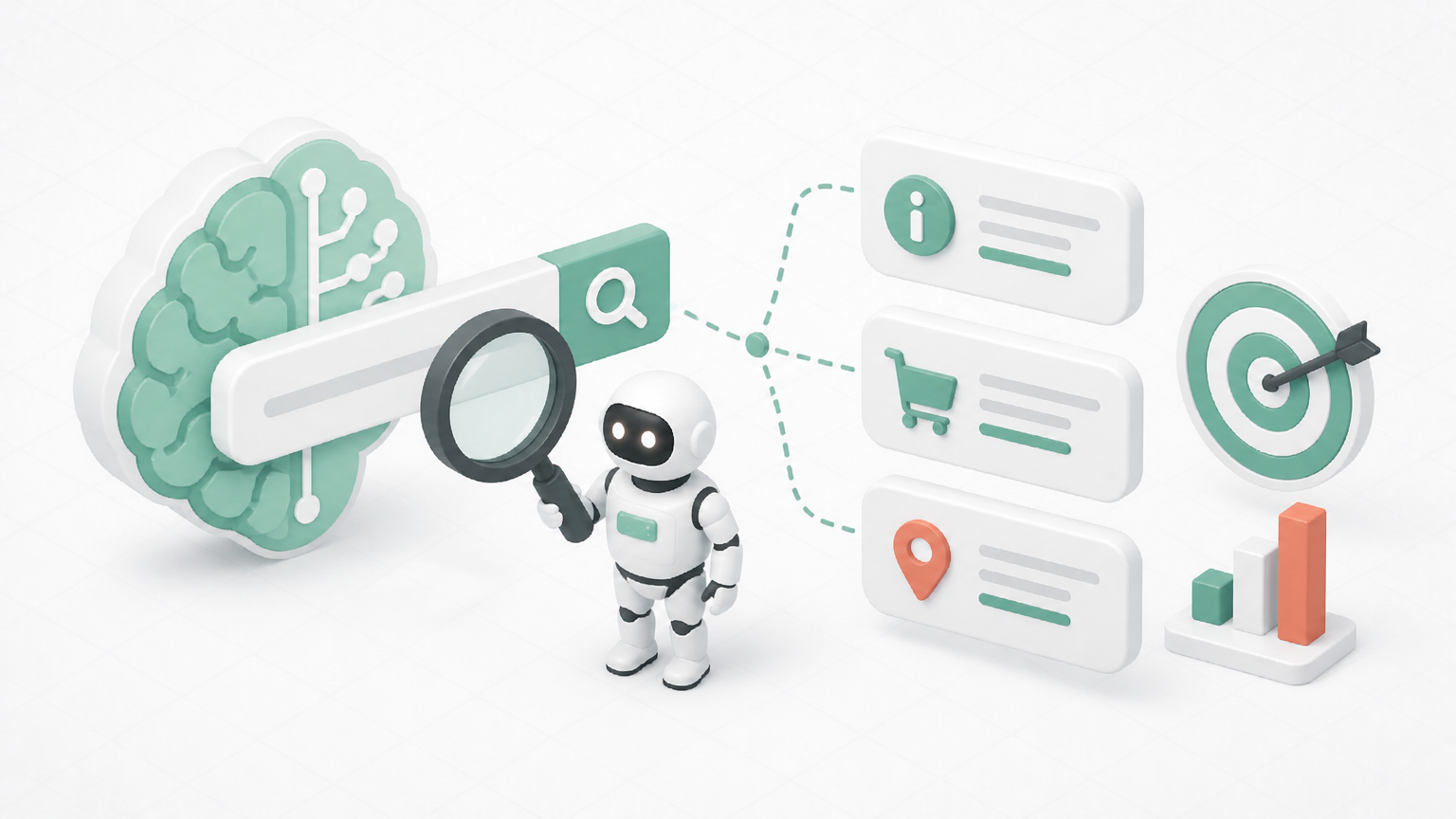
How AI Interprets Search Intent
Search visibility is no longer just about matching keywords. It is about matching meaning. If your content ranks poorly despite solid on-page SEO, the problem is often not authority or links, it is in…

How to Use AI to Write SEO Content: Best Practices and Risks
AI can help you publish faster, cover more keywords, and reduce content production costs. It can also flood your site with thin pages, factual errors, and generic copy that never ranks. That tension i…

Semantic SEO: Optimize for Meaning, Not Just Keywords
Most SEO content fails for a simple reason. It targets phrases, but misses intent. That gap matters more than ever. Search engines no longer rank pages only because they repeat a keyword in the title,…