
AI Search: Why Branded Web Mentions Are the New Backlinks
Ole N. Mai
Founder of Keupera
In AI search, Branded Web Mentions (whether linked or unlinked) are the new backlinks. 🌸
If you want AI models to actively recommend your company, you must master how semantic engines build trust, measure your generative footprint, and learn to reverse-engineer their hidden citation graphs.
Read this guide to get cited by AI. You can thank me later. ;)
1. The Semantic Shift: Why Words Trump Code
To understand this shift, you have to look at how large language models are trained. A traditional search engine uses the web's link graph to find paths. A backlink is essentially a structural directive: "Go here next."
An LLM, however, learns through semantic entity association. It digests billions of web pages, discussion threads, and regulatory documents to understand how entities connect. When your brand name is continuously dropped next to specific industry keywords, problems, and solutions, the model's internal neural weights shift.
Traditional Link Building: Tells an engine where to navigate.
Branded Web Mentions: Teach an engine what entity to trust.
If a prominent tech blog writes, "We solved our team's cross-border payroll issues using Company X," an LLM processes that full sentence context. Even if the writer forgets to attach a hyperlink, the model registers the entity "Company X" as structurally tied to the entity "cross-border payroll." When a user asks an AI chat tool for payroll recommendations, the model pulls from that conceptual map, not a link graph.
The Data: Mentions vs. Backlinks
Comprehensive data checking brand visibility factors across 75,000 distinct brands shows an undeniable correlation gap favoring mentions over links when it comes to appearing in AI-synthesized search snapshots.
The table below breaks down the specific Spearman correlation coefficients (r) determining whether a brand gets surfaced and cited inside AI search spaces:
Off-Site Visibility Signal | Correlation with AI Presence (r) | Statistical Impact Level |
Branded Web Mentions (Linked or Unlinked) | 0.664 | Dominant Predictive Vector |
Branded Anchor Text | 0.527 | Strong Associative Signal |
Branded Search Volume (Direct Search Lift) | 0.392 | Moderate Demand Signal |
Total Domain Rating (DR) | 0.326 | Moderate Foundation Signal |
Traditional Backlinks (Raw Volume) | 0.218 | Weak Architectural Signal |
Data confirms that branded web mentions (r = 0.664) correlate nearly three times more strongly with AI search visibility than traditional backlink volume (r = 0.218). Raw link numbers are take-a-backseat metrics; earned entity footprint is the primary driver of AI recommendations.
2. The Geometry of AI Share of Voice (SOV)
Because AI environments compress thousands of potentially competing options into a tight selection of 3 to 5 summarized recommendations, your visibility is binary. If your company fails to cross this conversion filter, your visibility effectively drops to zero.
To measure your true footprint, you must calculate your weighted AI Share of Voice:
AI SOV = (Sum of (Mentions of Brand * 𝑤_Prominence) / Sum of Mentions of Total Category) * 100
Where the prominence weight (𝑤_Prominence) scales based on whether your brand is explicitly recommended in the primary text summary, featured alongside a clickable hyperlink citation, or relegated to a background source token. A high raw citation count is meaningless if a competitor consistently captures the primary conversational narrative.
To accurately compile this baseline, you must construct a structured prompt library that mirrors the actual discovery funnels of real buyers across three core operational layers:
Informational / Brand-Agnostic Prompts: Target the top of your funnel. Focus on structural industry questions where an engine must choose which industry entities to cross-reference as examples. (e.g., "What are the best frameworks for scaling enterprise cybersecurity infrastructure?")
Commercial / Evaluation Prompts: Impact mid-funnel pipeline velocity. Users look to isolate options, request comparison tables, or actively seek structural trade-offs between solutions. (e.g., "Compare the top CRM platforms for mid-market logistics companies based on implementation speed.")
Transactional / Brand-Specific Prompts: Check your defensive positioning. Verify if AI engines adequately channels your documentation, surfaces true customer sentiment, or accurately understands your specialized feature sets. (e.g., "Does [Your Brand] support native zero-trust architecture for local networks?")
3. The Infrastructure Crisis: Manual Tracking vs. Reality
For resource-constrained teams trying an initial audit, building a basic manual testing rig illustrates the core mechanics of AI extraction. To track this manually, an analyst must follow a rigid blueprint:
Establish Clean Sandbox Environments: LLMs utilize active context windows and logged-in user accounts to personalize outputs. To get unbiased data, you must query completely clean, unauthenticated API endpoints or incognito instances to simulate a first-time buyer.
Isolate and Trace Citations: When an engine names your brand, you have to manually expand the citation boxes or footnote links to verify the source. Is the model referencing your owned website, an independent review platform, or an unlinked forum thread on Reddit?
Map Narrative Context: Classify the sentiment of every mention into a three-tiered matrix: Positive Recommendation (the AI actively suggests you), Neutral Mention (you appear passively in a list), or Negative Exclusion (the AI highlights a competitor's advantage over you).
While a manual audit can give you a static snapshot for a single day, it breaks down under the weight of scale. If you are tracking a modest universe of 200 priority prompts across four major AI engines, you are looking at 800 manual queries, source verifications, and sentiment classifications every single week.
This operational bottleneck is exactly where Keupera comes into play.
4. Diagnosing Your Brand Entity: A Real-World Case Study
The most dangerous mistake you can make right now is assuming that because your website looks modern, AI engines understand who you are. They don't. If your brand footprint lacks structure, LLMs see you as an ambiguous string of text, not a verified entity.
To illustrate how catastrophic a hidden entity crisis can be, let’s look at a diagnostic snapshot generated by Keupera's Brand Identity tool for an emerging platform called ManyPI (operating on the domain https://manypi.com):
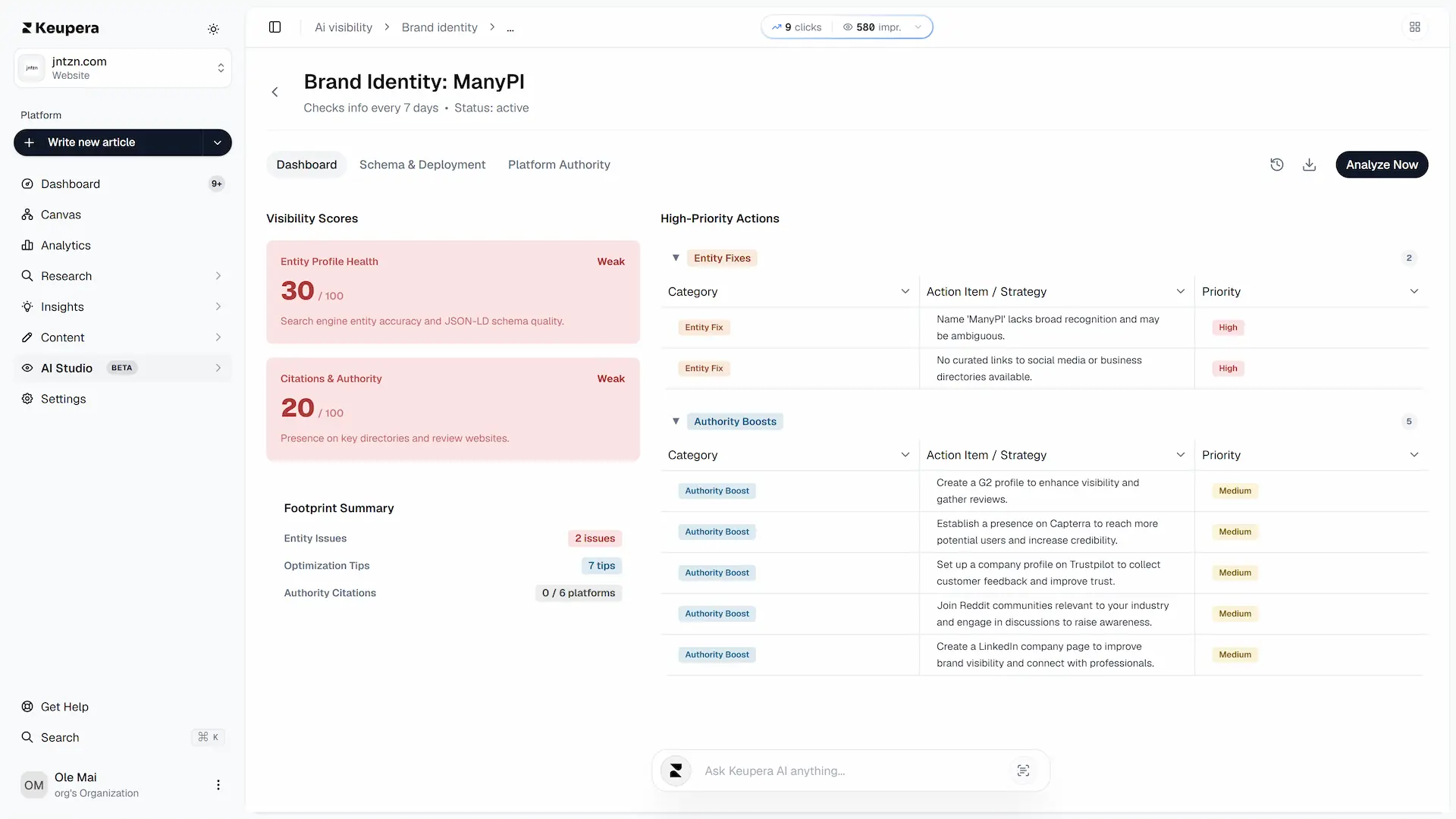
The Dashboard Diagnostic
When analyzing a brand, Keupera evaluates two critical algorithmic pillars: Entity Profile Health and Citations & Authority.
Entity Profile Health (30/100 - Weak): This means search engines and LLMs have an incredibly fuzzed view of what the brand actually does. The internal schema quality is poor, meaning AI crawlers are left to guess the business category.
Citations & Authority (20/100 - Weak): The brand has zero validation across the primary off-site trusted nodes that LLMs use to corroborate facts.
Keupera automatically identifies the highest-priority algorithmic roadblocks holding the brand back. For example, the tool flags that the name 'ManyPI' lacks broad recognition and remains highly ambiguous to language models, while simultaneously noting a total lack of curated links connecting the domain to verified business directories or social profiles.
The Platform Authority Gap (The Web Mentions That Matter)
To pull your brand out of the "Weak" zone, you have to build validation across what we call the Core Entity Validation Nodes. LLMs do not scrape the entire web equally when validating an organization; they prioritize highly moderated, high-authority ecosystems to cross-reference data.
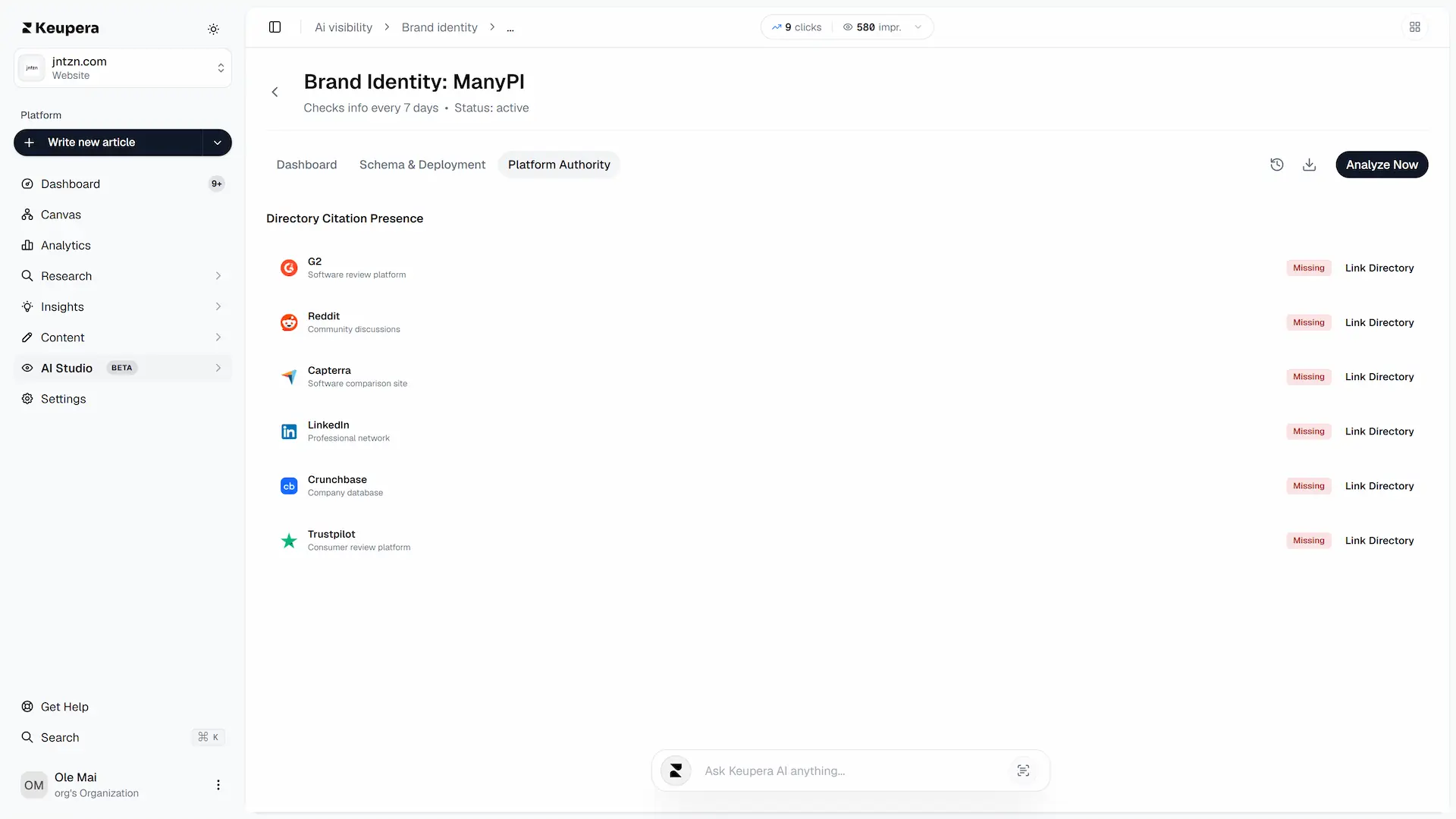
When analyzing Keupera's Platform Authority portal, we can see exactly where a brand's entity validation can completely drop off the map:
G2 & Capterra: Marked as Missing. Because these are primary software review platforms, LLMs constantly scrape them to build "Best software for..." comparison tables. If you are missing here, your commercial intent visibility is effectively 0%.
Reddit: Marked as Missing. Modern AI search platforms heavily weigh Reddit threads to extract authentic human sentiment. Without active brand mentions in relevant subreddits, an LLM lacks the behavioral data to recommend you.
LinkedIn & Crunchbase: Marked as Missing. These serve as the foundational structural records for corporate entities. If an AI cannot verify your company size, leadership, or active corporate footprint, it flags the entity as a low-trust risk.
Trustpilot: Marked as Missing. Consumer trust metrics provide the baseline sentiment score that prevents an AI engine from excluding your brand due to negative or absent customer feedback.
5. Reversing the AI Citation Graph & Tracking Volatility
Because web mentions are the core currency of AI visibility, you cannot find them inside a standard, legacy backlink tool. Traditional crawlers look for explicit link code; they completely ignore the semantic relationships that LLMs rely on.
To map how an LLM connects an external digital footprint to a specific brand, Keupera's AI Brand Radar features an Authority Matrix that maps the exact neural pathways generative search engines use during a Retrieval-Augmented Generation (RAG) pull.
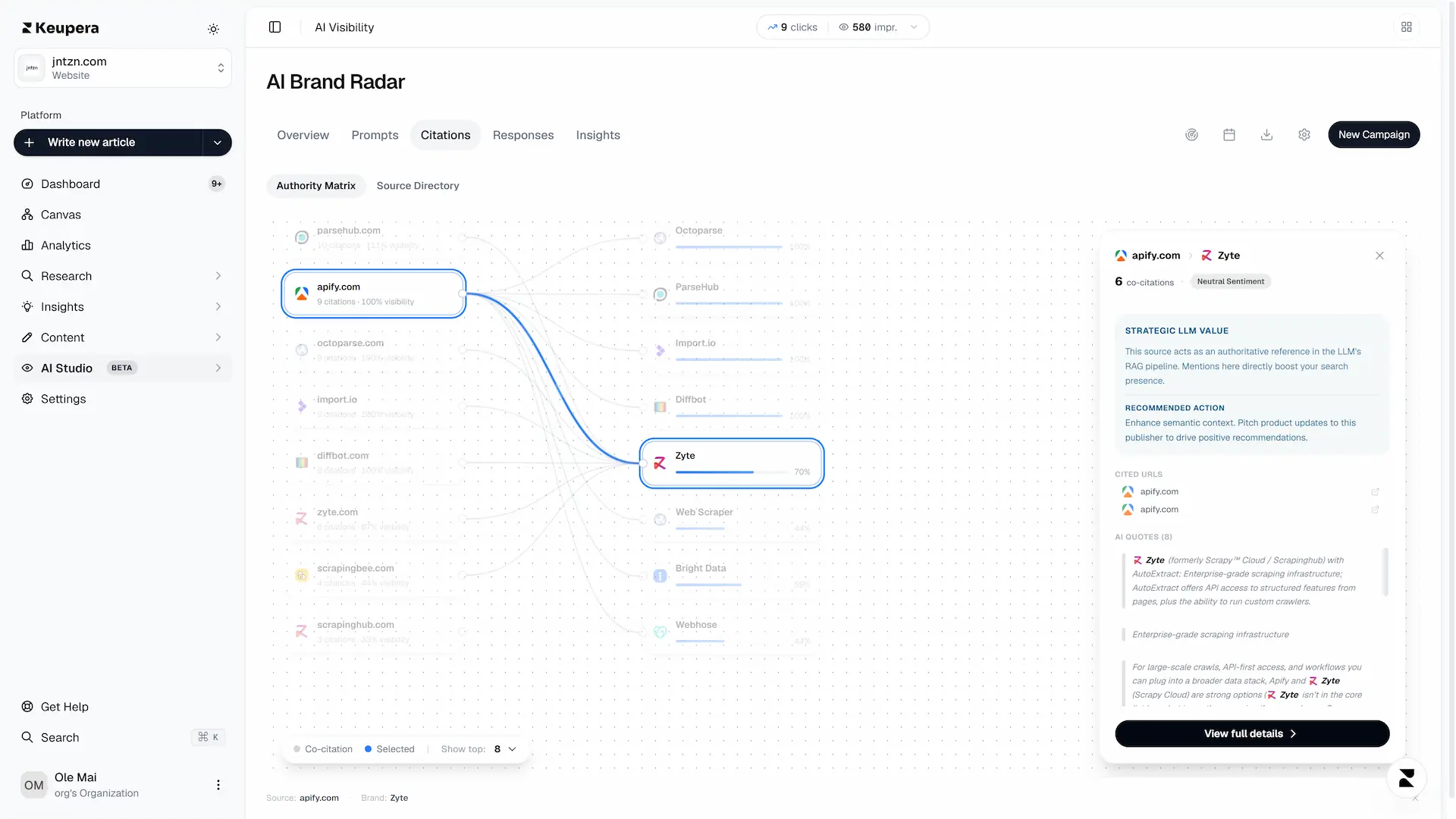
The AI Authority Matrix
The platform maps out exactly which websites act as foundational validation sources for the LLM. Rather than guessing why an AI engine recommended a competitor, you can isolate the specific source nodes, view the exact co-citation counts, and evaluate the underlying sentiment score.
For example, you can visually trace how highly authoritative third-party source nodes (like apify.com) feed direct visibility into specific brand entities (like Zyte).
On the right-hand panel, the system extracts the definitive AI Quotes. The precise text blocks the model scraped from the source domain to synthesize its conversational answer. This allows you to see exactly how your brand message is being parsed, processed, and repackaged by the AI.
Tracking Visibility Waves and Competitive Volatility
Unlike static keyword rankings, AI share of voice behaves like a wave; constantly fluctuating based on the real-time context of the user’s prompt and subtle tweaks to an LLM's system instructions.
Observing the AI Brand Radar Overview, you can monitor how visibility percentages among a competitive cluster (such as Diffbot, ParseHub, Zyte, and Import.io) dance dynamically between 10% and 25% over a multi-day timeline.
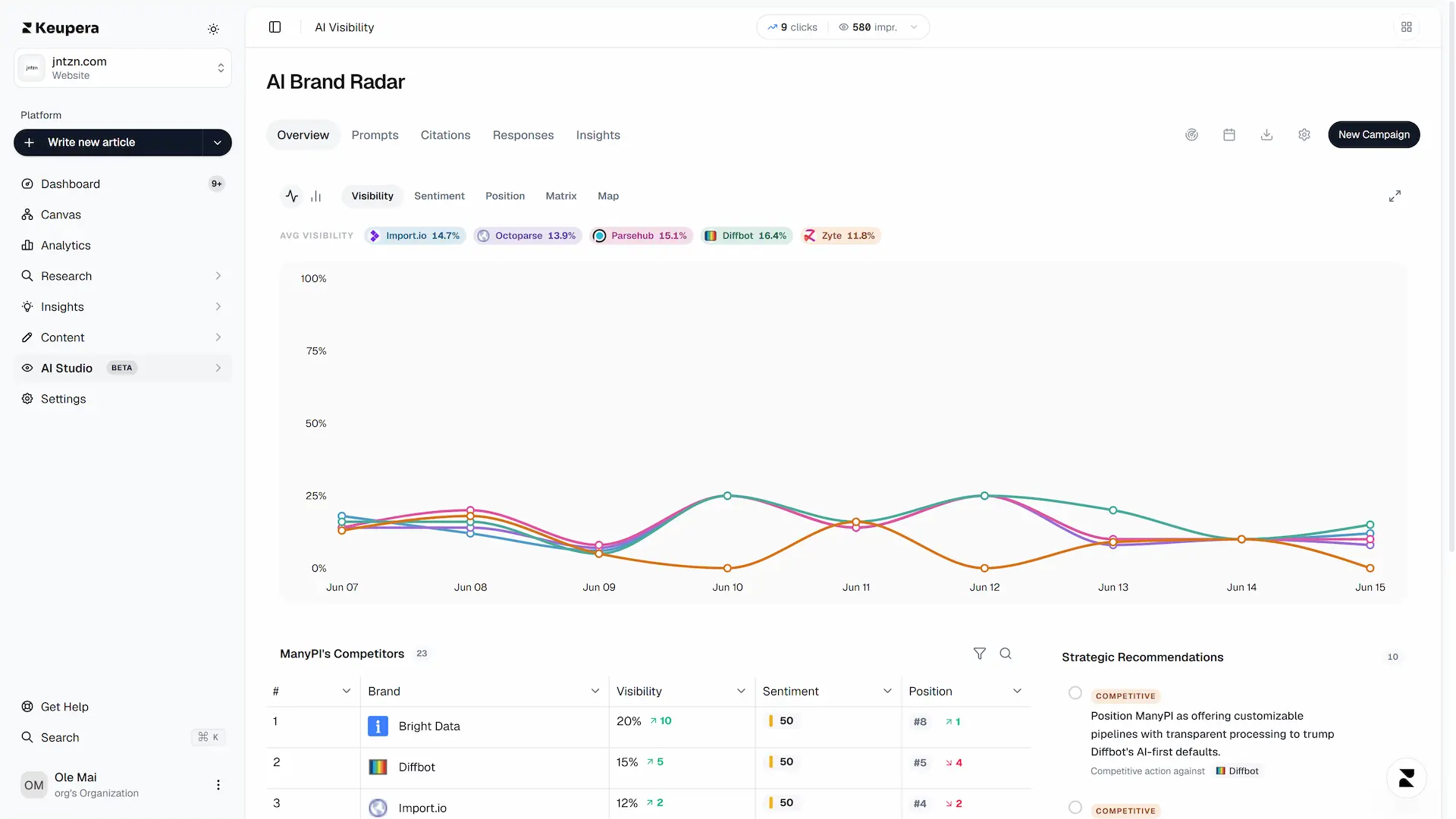
Keupera continuously captures these micro-fluctuations, aggregating your organic share of voice across ChatGPT Search, Perplexity, and Google AI Overviews into a single tracking timeline. Crucially, the dashboard pairs its real-time visibility and position metrics with an automated Strategic Recommendations feed.
It looks at your competitive footprint and tells you exactly how to adjust your content angles to counter a rival's current momentum (e.g., "Differentiate ManyPI by marketing its more flexible and scalable API-first scraping workflows and stronger data delivery guarantees than Octoparse").
Auditing Your Source Directory DNA
To systematically grow your unlinked branded mentions, you must understand where the AI prefers to pull its data for your specific industry. Does it favor corporate marketing sites, or is it leaning heavily on independent documentation and reference nodes?
By diving into Keupera's Source Directory, you can analyze the DNA of every domain feeding the AI’s knowledge base. The platform automatically classifies your mention sources, mapping out the distribution split - such as a 74% Corporate vs. 26% Reference distribution.
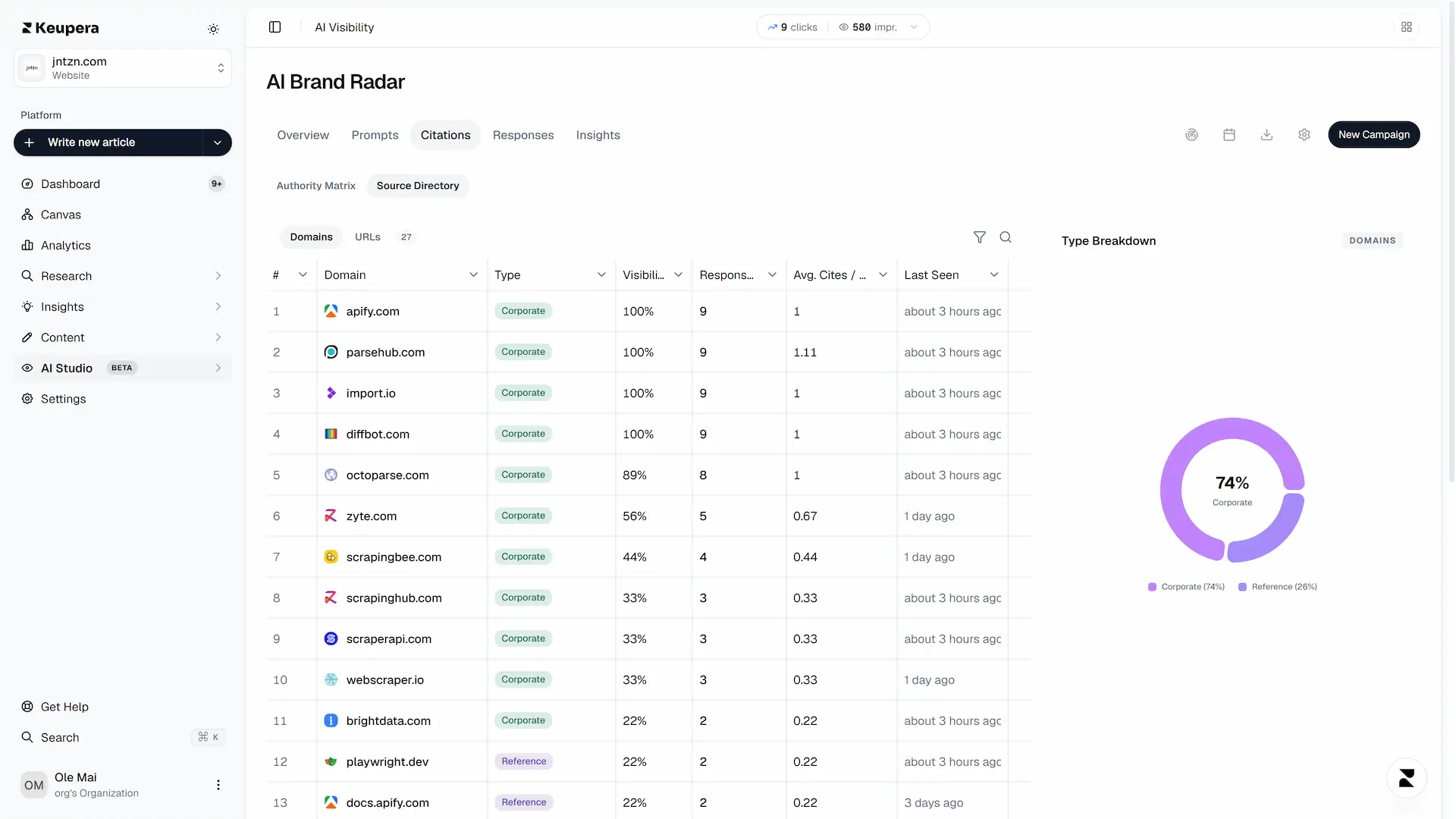
If the LLMs dominating your niche draw three-quarters of their context from corporate sites, your digital PR needs to target corporate blogs, thought leadership platforms, and brand partnerships. If the scale tips toward reference nodes, your budget must shift toward open-source documentation, wikis, and technical repos.
6. Turning Insight into Action: GEO Execution and Deployment
Once you know where your gaps are, you must apply immediate optimizations to your site architecture to feed the AI engines a definitive, machine-readable declaration of who you are.
Step 1: Deploy Advanced JSON-LD Schema
Inside Keupera's deployment workspace, you can construct an immutable entity map that explicitly links your domain to your wider digital footprint:
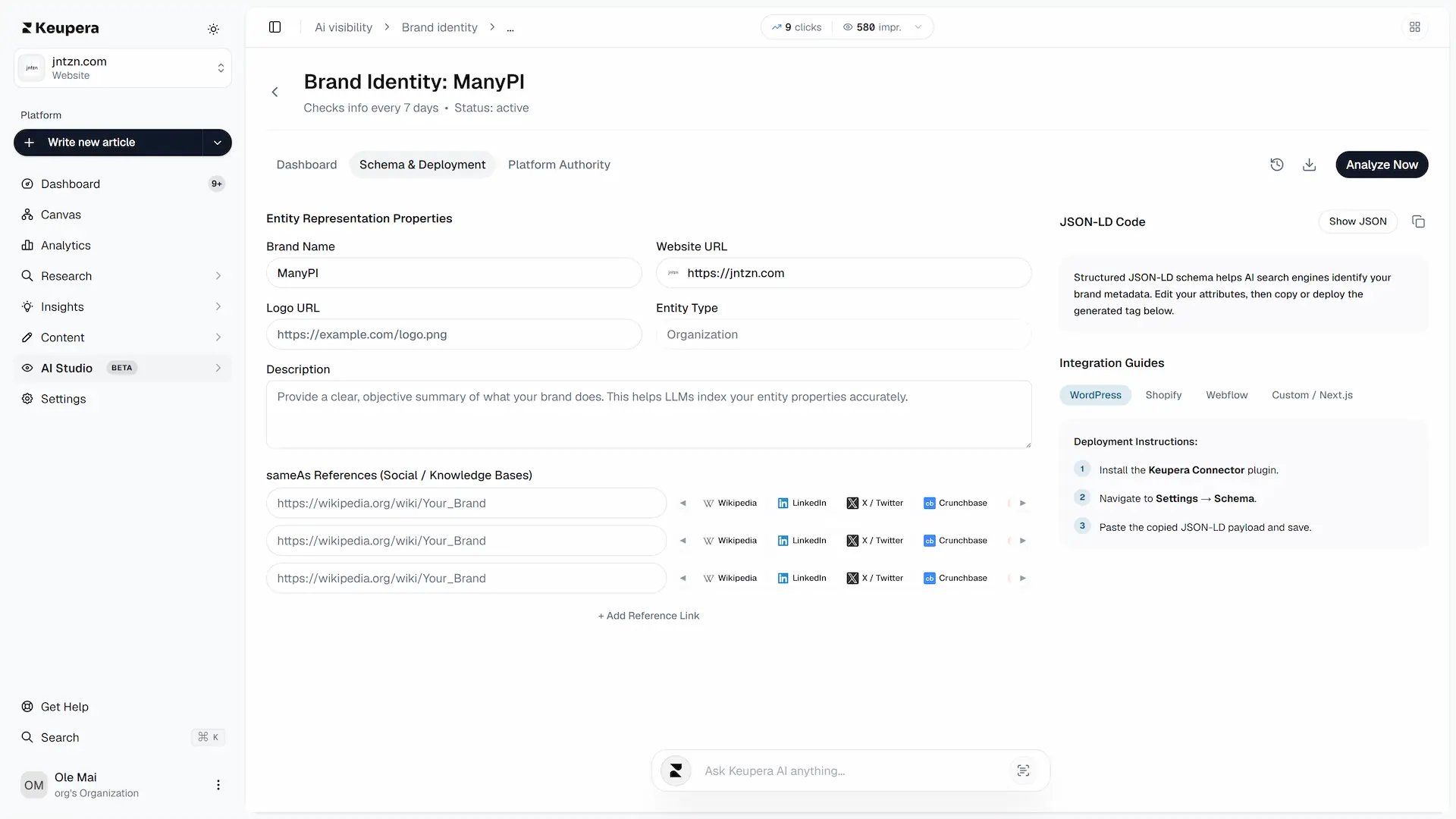
Explicit Entity Properties: Define your precise Entity Type (e.g.,
Organization) and write a clear, objective, fluff-free description. This gives LLMs a direct, scannable summary to index without having to decipher vague marketing copy.The
sameAsReference Bridge: This is the ultimate tool for resolving entity ambiguity. By mapping your verified Wikipedia, LinkedIn, X, and Crunchbase URLs into thesameAsarray of your schema, you are structurally telling the AI: "All of these web mentions across these different platforms belong to the exact same corporate entity."Instant Automated Deployment: Instead of manually writing syntax and risking code errors, you can generate the exact JSON-LD payload natively. Using integration systems like the Keupera Connector plugin, you can deploy this entity metadata directly to your environment (whether you are on WordPress, Shopify, Webflow, or Next.js) in seconds.
Step 2: Fix Passages for the "Isolate Rule"
Ensure your own pages feature direct, un-fluffy structural answers. The "Micro-Context Rule" dictactes that every single sub-section (H2 or H3) must make perfect sense if read entirely in isolation. If an LLM needs to parse 800 words of background text to locate a simple feature spec, it will bypass your page for a competitor's tightly structured table or bulleted list.
Step 3: Diversify Off-Page Footprints
If your AI Share of Voice stalls despite flawless on-page optimization, your brand lacks conversational relevance. Prioritize targeted digital PR, engineering review pipelines, and active placement on primary industry source sites highlighted by your source directory audit.
Conclusion: The New Standard for Search Dominance
To capture market share, brands must treat AI engines as a critical acquisition channel.
Stop guessing your AI share of voice.
Sign up for Keupera today to get customers from AI search.
Learn more about AI SEO and how it differs from traditional SEO and GEO.
More in AI & GEO
Keep reading

10 Best GEO Tips for Startups and Agencies
If your content is still optimized only for blue links, you are already behind. Search behavior has changed fast. People now ask AI assistants, answer engines, and generative search tools to summarize…

How to Optimize for Conversational Queries and AI Search
Make your content easier for AI systems to find, trust, and quote, without sacrificing human readability. Microcopy: You do not need a full site rebuild. Most teams can test this on one page first and…
How to Get Your Brand Cited by LLMs
If AI can answer your buyers before your site ever gets a click, visibility has changed. The new challenge is not just ranking in the SERP, it is making sure your brand is present when large language …