A Practical Guide to Topic Clusters for Content and SEO
Bastian W.
Co-Founder of Keupera
Organizing content by isolated keywords is one of the fastest ways to create thin pages, confuse search engines, and stall organic growth. If your site has useful content but uneven rankings, weak internal linking, or pages competing against each other, your structure may be the real problem.
A topic cluster model fixes that. It helps you group content around a core theme, align pages to search intent, and build a cleaner path for users and crawlers. For startups and agencies, that means a more scalable content strategy, stronger SERP visibility, and clearer reporting on what is actually working.
Build topic clusters well, and you do more than publish content. You create a system. One that maps pillar pages, supports long-tail rankings, and turns your content library into an asset instead of a backlog.
Build Topic Clusters That Drive Organic Growth
Organize your content around core topics to improve SERP visibility, internal linking, and user experience.
We’ll map pillar pages, cluster ideas, and recommended internal links. No credit card needed.
What Are Topic Clusters?
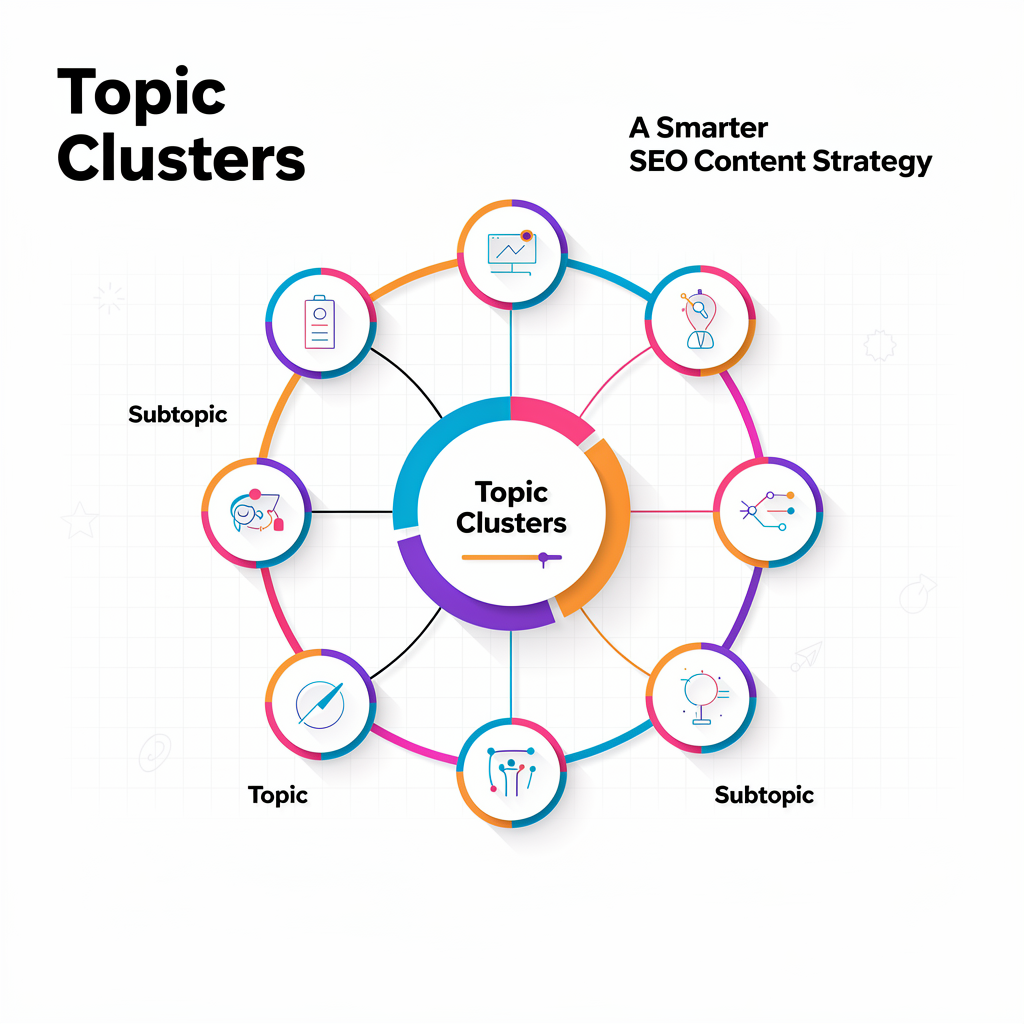
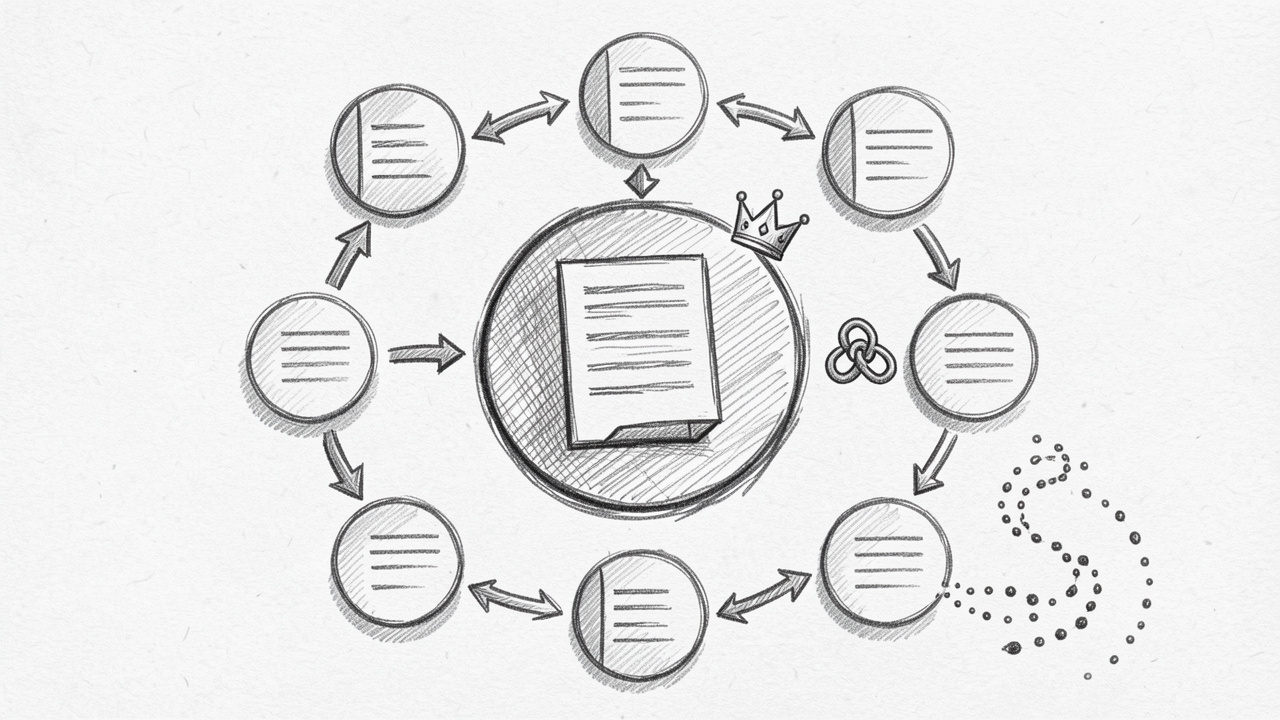
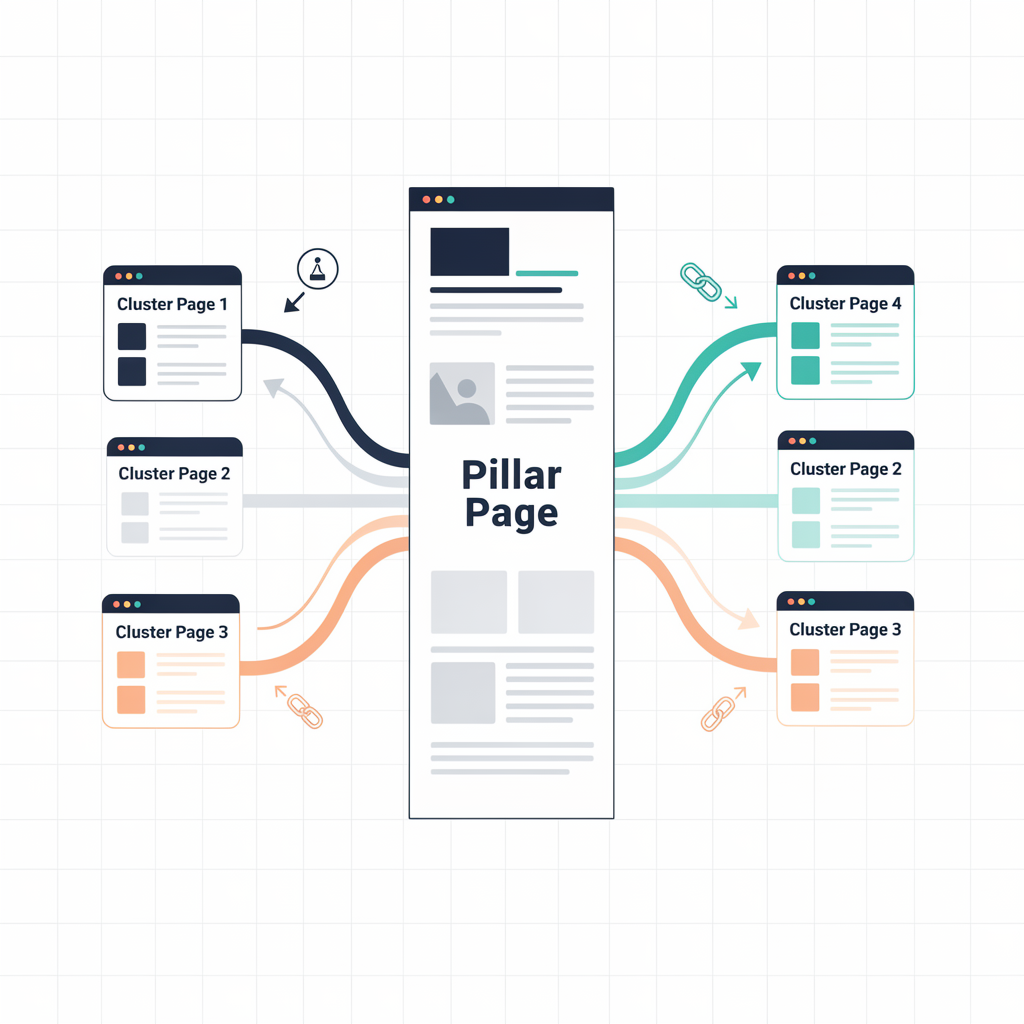
A topic cluster is a content model built around one broad pillar page and several related cluster pages. The pillar covers the main subject at a high level, while the cluster content goes deeper into specific subtopics, questions, or use cases. Internal links connect them all.
Think of it like a well-organized library. The pillar is the main shelf label. The cluster pages are the books. Internal links are the catalog system that helps both readers and search engines move through the collection efficiently.
This matters because Google no longer evaluates pages only as standalone assets. It also looks at context, relationships, and relevance across a site. A clear cluster structure helps reinforce topical authority, improves crawlability, and increases your chances of ranking for both head terms and long-tail queries.
A few terms matter here. A pillar page targets a broad topic. Cluster content targets narrower intent around that topic. Internal linking helps distribute relevance and Page Authority between pages. In the SERP, this structure can improve coverage, especially when your site already has decent content but lacks a clear architecture. If your site has growing Domain Authority, clusters help you use it more effectively.
Why Topic Clusters Work, The SEO Logic
Search engines reward depth when it is structured clearly. If you publish ten unrelated blog posts, you may pick up some impressions. If you publish one pillar and ten strategically linked support pages, you send a much stronger signal about the subject your site covers well.
That signal matters more today because search has become more semantic. Google uses systems that interpret related concepts, intent patterns, and entity relationships, not just exact-match keywords. A strong cluster helps your content align with that model. You are not just targeting phrases. You are proving subject coverage.
Internal links are the second reason this works. They connect related pages, reduce orphan content, and guide crawlers toward your priority assets. A page with strong internal support often performs better than an equally strong page left alone. In practice, agencies often see better impressions, longer session duration, and fewer underperforming thin pages after a cluster restructure.
Clusters also capture more search intent. One pillar might target a broad term like “customer onboarding software,” while supporting pages target “onboarding checklist,” “onboarding email examples,” “user activation metrics,” and “SaaS onboarding best practices.” Together, those pages help you rank for a wider range of queries without forcing one page to do too much.
When to Use a Cluster Strategy
A cluster strategy makes sense when you are launching a new content hub or rebuilding an old one. It is especially useful if your site has dozens of posts but no obvious hierarchy.
It is also the right move when you notice keyword cannibalization. If multiple pages target variations of the same intent and none of them rank well, consolidating them into a pillar-and-cluster model can create clarity.
You should also consider clusters when you want to scale predictably. For agencies and in-house teams, clusters make planning easier. You can assign one business theme, define supporting intents, and build around it without creating duplicate or disconnected content.
How to Build Topic Clusters Step by Step
Below is a practical seven-step process to build clusters that actually perform.
Step 1, Choose a Pillar Topic
Start with a broad topic that matters to your audience and business. It should be large enough to support multiple subtopics, but focused enough to map to a clear commercial or informational theme.
For a SaaS company, a pillar topic might be customer onboarding, email deliverability, or project management workflows. For an agency, it might be local SEO, technical SEO audits, or link building. The best pillars sit at the intersection of search demand, business relevance, and content depth.
Check whether the topic already earns impressions in Google Search Console. If it does, you may already have momentum. Also review the current SERP. If results include guides, templates, tools, and subtopic articles, that is usually a strong sign the topic can support a cluster.
Step 2, Research Related Subtopics and Intent
Once the core theme is set, expand outward. Use Google Search Console, Ahrefs, SEMrush, and SERP analysis to find related questions, modifiers, and adjacent use cases.
Do not group terms by volume alone. Group them by intent. Some queries want a guide. Others want a comparison, checklist, template, or product page. If you ignore that distinction, you will create pages that miss the user’s actual need.
A practical example helps. If the pillar is customer onboarding, likely clusters include onboarding emails, onboarding checklists, in-app walkthroughs, time-to-value, onboarding metrics, and onboarding automation. Those are not just keyword variations. They represent distinct tasks and stages in the user journey.
Step 3, Map Keywords to Pages
This is where many content strategies fail. Teams gather keywords, then spread them across pages inconsistently. A cluster model works only when each page has a clear role.
The pillar should target the broad parent topic. Cluster pages should target narrower subtopics that support the main theme without overlapping too heavily. If two keywords return nearly identical SERPs, they probably belong on one page, not two.
Build a simple content map before writing. Assign each primary keyword, its supporting secondary terms, the intent type, and the target URL. This reduces cannibalization and makes internal linking much easier later.
Step 4, Create and Optimize the Pillar Page
Your pillar page should be authoritative, structured, and easy to scan. It is not a giant wall of text. It is a central resource that introduces the topic, answers high-level questions, and links naturally to deeper cluster pages.
In most cases, a strong pillar runs between 1,500 and 3,000 words. That range is not a rule, but it is a practical benchmark for balancing depth and usability. Use clear H2s and H3s, add definitions early, and include sections that reflect the main subtopics you plan to support.
On-page SEO still matters. Write a focused title tag, a concise meta description, and a clean URL. Use schema where appropriate, especially for articles, FAQs, or how-to content. If similar versions exist, apply canonical tags correctly so your pillar remains the primary asset.
Step 5, Produce Cluster Content
Cluster articles should go deeper than the pillar on one specific subtopic. Their job is not to repeat the overview. Their job is to satisfy narrow intent completely.
A practical benchmark is 800 to 1,500 words per cluster page, though some competitive topics need more. The format should match the query. A comparison article should compare. A checklist should be immediately usable. A tutorial should walk step by step. Search intent should decide the structure.
This is where content teams gain leverage. If your pillar is about customer onboarding, cluster pages can target onboarding templates, onboarding analytics, feature adoption, pricing communication, integrations, or implementation timelines. Each page expands your topical footprint while strengthening the pillar.
Step 6, Implement a Clear Internal Linking Strategy
Internal links are the connective tissue of topic clusters. Without them, you simply have related content. With them, you have a real structure.
Every cluster page should link back to the pillar using descriptive anchor text that reflects the relationship naturally. The pillar should also link out to each supporting page in the relevant section. Where useful, cluster pages can link laterally to closely related articles, but do not overdo it.
A good operating benchmark is simple. Each cluster page should include at least one link to the pillar, and the pillar should link to all core clusters. Important pages should sit within three clicks of the homepage when possible. Use mostly followed links for internal SEO pathways, and reserve nofollow only for edge cases where you truly do not want to pass value.
Step 7, Track, Measure, and Iterate
Clusters are not a one-time publishing project. They improve through testing, consolidation, and refresh cycles.
Start by recording a baseline for rankings, impressions, CTR, organic sessions, and indexed pages. After launch, monitor which cluster pages begin earning impressions fastest. Those are often the best candidates for refreshes, stronger linking, or richer snippets.
Expect meaningful movement in 3 to 6 months if your site is indexed properly and the content quality is strong. Smaller sites may need more time. The key is to treat the cluster as a living system, not a static set of URLs.
Practical Templates and Checklists
Templates make cluster execution faster and more consistent, especially across startup teams and agencies managing several clients.
Pillar Page Template
Use this structure as a working model for a pillar asset.
Section | Purpose | Recommended Length |
Introduction | Define topic and match broad intent | 150 to 250 words |
Core overview | Explain the main concept clearly | 300 to 500 words |
Key subtopics summary | Preview supporting cluster themes | 400 to 800 words |
Use cases or examples | Add practical context | 200 to 400 words |
FAQs | Capture related questions | 150 to 300 words |
Internal links hub | Route users to cluster pages | Contextual throughout |
A strong pillar should link to every major support page. In many cases, a healthy ratio is 1 pillar to 6 to 12 cluster pages for a mature content hub.
Cluster Article Template
A cluster page works best when it has a narrow goal and a single dominant intent.
Field | Recommendation |
Primary goal | Answer one clear subtopic or query |
Target phrase | One main keyword plus close variants |
Search intent | Informational, commercial, or comparison |
Length | 800 to 1,500 words |
CTA | One next step, relevant to the topic |
Internal links | Link to pillar plus 1 to 3 related clusters |
Internal Link Checklist
This checklist helps keep link architecture useful and consistent.
Check | Best Practice |
Anchor text | Use natural descriptive anchors, not repetitive exact match every time |
Link depth | Keep core pillar and top clusters within 3 clicks |
Link direction | Pillar links down, cluster links up, related pages link sideways when relevant |
Nofollow use | Avoid nofollow for strategic internal links in most cases |
Orphan pages | Audit regularly and link any isolated content into a cluster |
Canonicals | Use when consolidation is incomplete or duplicate versions exist |
Tools and Data Sources
The best tool stack depends on your workflow, but the jobs stay the same: research demand, audit existing pages, map relationships, and track results.
Tool | Best For | What It Solves |
Google Search Console | Query and page data | Finds high-impression pages and emerging keyword themes |
Keupera Research | Keyword research and backlinks | Expands topic ideas, estimates difficulty, checks linking context |
Keupera SEO | Keyword mapping and gap analysis | Helps find missing subtopics and intent patterns |
Screaming Frog | Crawl audits | Finds orphan pages, duplicate titles, canonicals, and depth issues |
Surfer | Content optimization | Helps align headings, entities, and coverage with top results |
Google Analytics | Engagement monitoring | Tracks organic sessions, landing pages, and behavior trends |
If you want automation, look at clustering and topic modeling tools built into SEO platforms or dedicated SaaS workflows. These can group semantically related keywords at scale, which is useful when managing large content inventories. Still, do not outsource judgment entirely. Automated clusters need human review, especially for intent and overlap.
Common Mistakes and How to Avoid Them
The first common mistake is building a pillar page that is too thin. A short overview with no real structure does not establish authority. Fix this by making the pillar comprehensive, well-organized, and clearly connected to support content.
The second mistake is weak internal linking. Many teams publish cluster pages but forget to update older posts or link consistently back to the pillar. The fix is an anchor strategy and a repeatable QA step before publication. Every new cluster should strengthen the system.
The third mistake is cannibalization. If you already have several posts targeting nearly the same query, publishing another one will not help. Consolidate overlapping content, update the strongest URL, and use 301 redirects where needed. If consolidation must happen gradually, canonicals can help signal the preferred page.
The fourth mistake is ignoring intent. A page optimized for “best tools” should not read like a basic glossary. Match the content format to the SERP. That single decision often determines whether the page earns clicks or gets buried.
Measuring Success
The most important KPIs are straightforward. Track organic traffic, rankings for cluster keywords, impressions, and CTR. Those tell you whether your cluster is gaining visibility and winning clicks.
Engagement metrics add needed context. Time on page, pages per session, and assisted conversions can reveal whether users are actually moving through your content ecosystem. If cluster pages attract traffic but the pillar gets no internal visits, your linking model may need work.
Technical indicators matter too. Watch crawl depth, indexation status, duplicate content signals, and orphan page counts. A cluster strategy can underperform simply because Google is not reaching or indexing the right pages efficiently.
Use a monthly reporting cadence, but judge strategic outcomes over three to six months. That timeframe is realistic for most sites. For experiments, test one variable at a time, such as title angle, page structure, FAQ placement, or internal link prominence.
Real-World Examples and Mini Case Studies
A SaaS company builds a pillar around customer onboarding software and links to supporting pages on onboarding checklists, user activation, integrations, and onboarding metrics. Over four months, the pillar moves from page three to the middle of page one for several mid-intent terms, while feature pages supported by the cluster see a 20 to 40 percent lift in organic sessions. The key driver is not just new content. It is the improved relationship between educational and commercial pages.
An e-commerce brand has multiple thin pages targeting overlapping variations of “running shoe size guide.” Rankings are unstable, and Google rotates different URLs in and out of the SERP. After consolidating those pages into one pillar with supporting cluster content for fit, pronation, width, and brand-specific sizing, cannibalization drops and organic traffic to the section rises by 15 to 30 percent within three months.
A B2B service firm restructures its blog around a pillar for technical SEO audits. It then links related posts on crawl errors, indexation, canonical tags, and log file analysis back to that central resource. Within one quarter, long-tail keyword visibility improves, and several supporting articles move into the top 10 after sitting in positions 15 to 25 for months. The lift comes from stronger internal relevance and clearer topical grouping.
Advanced Tips for Scale, Governance, and Content Ops
As your cluster strategy grows, operations matter as much as ideas. The most effective teams assign a clear owner to each pillar, use standardized briefs, and publish with a QA checklist that covers metadata, intent match, links, schema, and canonicals.
Governance keeps the structure from drifting over time. Define naming conventions for URLs, anchor text patterns, and update cadences. For example, pillar pages may be reviewed every quarter, while cluster pages are refreshed based on impressions, CTR decline, or product changes.
If you operate in multiple markets, build localized clusters instead of simply translating one English structure word for word. Search behavior, SERP features, and modifiers differ by region. Multi-language clusters need local keyword research, local internal links, and country-aware canonical or hreflang implementation.
Content lifecycle management is just as important. Not every page deserves an update forever. Some should be refreshed. Others should be merged, redirected, or archived. Strong clusters become stronger when you remove duplication and keep only the URLs that serve a clear purpose.
Quick Wins You Can Implement Today
If you want momentum fast, start with a small restructure. Find three high-impression pages in Search Console that already touch related themes. Those are your best candidates for pillar development because Google already sees some relevance there.
Next, consolidate two or three thin pages that overlap heavily. In many cases, one stronger article will outperform several weak ones within weeks once redirects and internal links are in place.
Then add five internal links from high-traffic pages to your strongest pillar. This is one of the fastest ways to improve discovery, reinforce relevance, and direct users into the rest of the cluster.
FAQs
What’s the difference between a pillar page and a cornerstone page?
A pillar page is usually the central page in a cluster, while a cornerstone page is a broader editorial term for your most important content. In practice, they often overlap.
How many cluster pages should I create per pillar?
Start with 6 to 12 strong cluster pages per pillar if the topic supports it. Fewer is fine if the intent is narrow and the coverage is deep.
How long before I see results from content clusters?
Most sites see early movement in 3 to 6 months. Stronger domains and existing content can move faster.
Can cluster strategies help with voice search and featured snippets?
Yes, especially when cluster pages answer specific questions clearly and match conversational intent. Good structure improves your chances.
Do topic clusters work for small sites with low Domain Authority?
Yes. In fact, smaller sites often benefit even more because clusters help focus limited authority on a few important themes instead of spreading it too thin.
A strong cluster strategy makes your content easier to plan, easier to crawl, and easier to rank. It gives every page a job and every topic a structure. That is what turns content production into SEO leverage.
If you are building a new content engine or cleaning up years of scattered publishing, start with one pillar, a handful of tightly matched clusters, and a disciplined internal linking model. Then measure, refine, and scale.
More in Entity SEO
Keep reading

What are the 10 best Content Strategies to Plan, Create, and Scale That Convert?
If your team is publishing regularly but results still feel uneven, the problem usually is not effort. It is strategy. Content without a clear plan often leads to traffic without conversions, rankings…

What SEO Is and Why It Still Matters
In a hurry? You can find our SEO Checklist . If your website is hard to find, it might as well not exist. That is the practical reason SEO still matters to startups, agencies, and growth teams tryin…